Patient info
Your office visit: what to expect
Our goal is the healthy, straight smile you've always wanted. Your first visit should be relaxing, comfortable — and even fun.

First visit
Every smile starts with a free consultation
At your initial consultation you will:
- Meet our friendly team and learn more about orthodontics.
- Receive a thorough oral exam, including X-rays, to see whether treatment is needed.
- Review your dental and medical history.
- Discuss treatment options tailored to your needs.
- Go over cost, insurance and payment plans that make treatment affordable.
After your consultation
If treatment is recommended, we schedule your next visit to place your braces or start aligners. That appointment typically lasts 1–2 hours, and we make sure you're comfortable and informed every step of the way.
Scheduling
Regular visits keep treatment on track. We accommodate your preferred days and times whenever we can — and if you're running late or need to reschedule, just let us know.
Keep seeing your dentist
Continue visiting your family dentist every six months for cleanings and checkups. We coordinate with your dentist when additional care is needed.
Forms
Patient forms: prepare for your first visit
Register online
Please complete the New Patient form, Informed Consent and HIPAA form before your first appointment.
Prefer paper?
Print and fill out the Health History form and HIPAA Notice of Privacy Practices, then bring them with you. Spanish versions are available — formularios en español disponibles.
See all forms, financing and insurance details on Patient Resources.
7 and Up Kids Club
Why see an orthodontist by age 7?
Treatment most often starts between ages 11 and 14, but some problems are best corrected earlier. The American Association of Orthodontists recommends every child see an orthodontist by age 7. By then the first adult teeth have usually come in, and a specialist can spot early warning signs.
Early detection doesn't always mean early treatment. When it is appropriate, early care — like making space for permanent teeth or guiding jaw growth — can reduce the need for more extensive treatment later.
Our complimentary exam checks teeth, jaws, gums, smile, facial balance, airway and jaw joints.
Learn about early treatment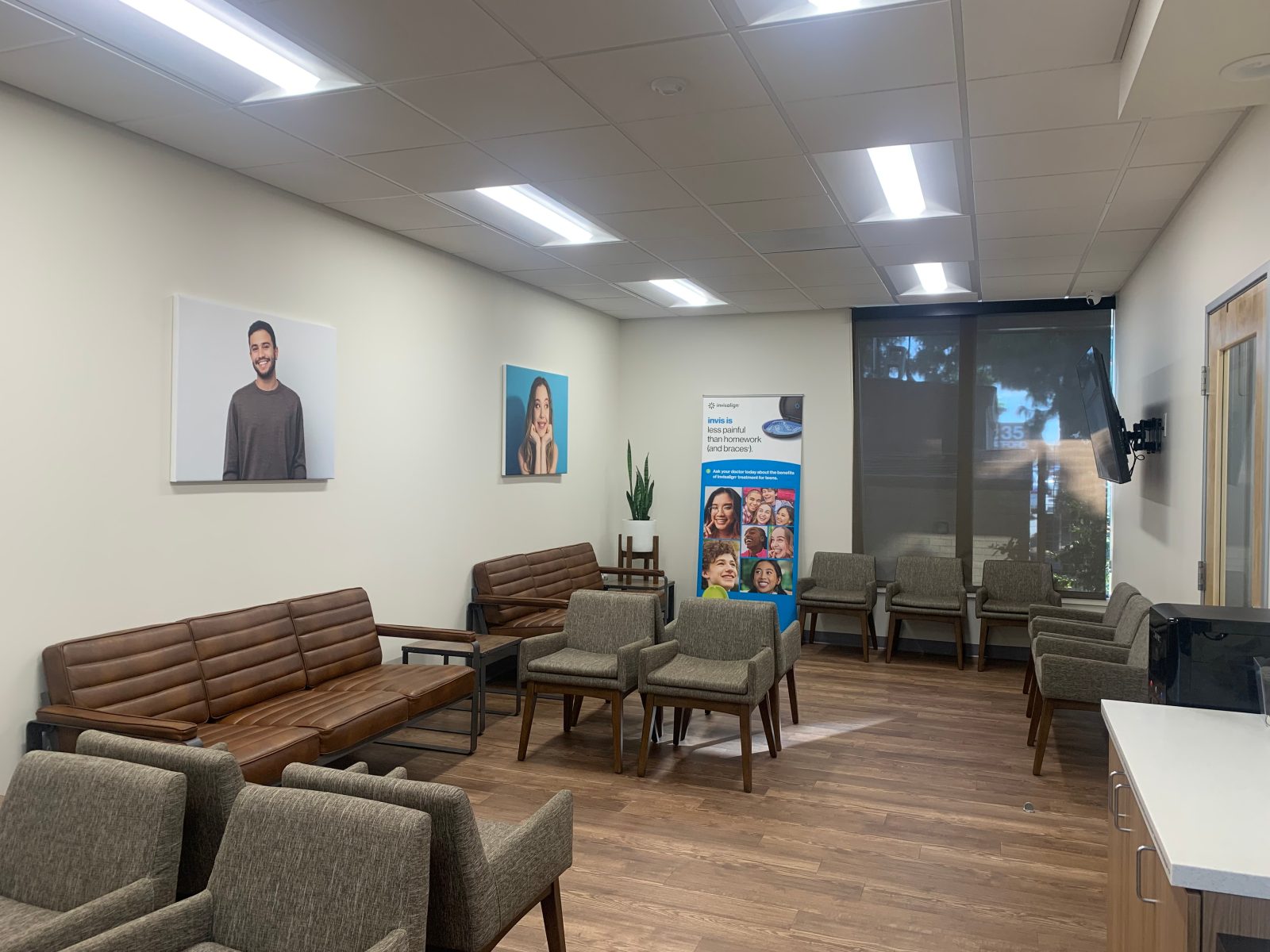
Signs the bite isn't right
Do the upper teeth protrude?
Excessive protrusion of the upper front teeth ("buck teeth") is the most common orthodontic problem.
Is there a deep bite?
The upper front teeth cover the lower front teeth too much.
Is there an underbite?
The upper teeth fit inside the arch of the lower teeth.
Is there an open bite?
Your child can fit their tongue between the upper and lower front teeth when the back teeth are together.
How is the spacing?
Crowded or overlapping teeth, or noticeably large gaps between teeth.
Do the midlines line up?
The space between the two upper front teeth and the two lower front teeth should line up with the bridge of the nose.
Technology
Modern tools for comfortable, precise care
iTero digital scans
No goopy impressions — a quick 3D scan of your teeth, plus a preview of your new smile.
Digital X-rays
Lower-radiation imaging that lets the doctor see roots, jaws and developing teeth.
Invisalign Diamond Plus
Among the most experienced Invisalign teams in the region, for kids, teens and adults.
Emergencies
Orthodontic emergencies
True emergencies are rare. For facial swelling, trauma to the face or mouth, or severe pain, seek emergency care, then call your office.
Loose bracket or band
If it is still attached to the wire, leave it in place and cover it with orthodontic wax. Call your office to plan a repair.
Poking wire
Use a pencil eraser to gently push the wire flat, or cover the end with wax. Never cut a wire unless our team tells you to.
Sore teeth or cheeks
Mild soreness for a few days after adjustments is normal. Warm salt-water rinses and an over-the-counter pain reliever usually help.
Lost or broken aligner or retainer
Move to your next aligner (or back to your last one) and call us. Do not go without a retainer — teeth can shift quickly.
Aftercare
Keeping your new smile
Wear your retainer
Teeth naturally want to drift. Wear your retainer exactly as directed — usually full-time at first, then nightly.
Retainer careBrush, floss, and check in
Clean your retainer daily, keep it in its case, and bring it to follow-up visits so we can check the fit.
Patient FAQ
How long is the first visit?
Plan for about an hour. We take records (photos and X-rays), the doctor examines your teeth and bite, and we go over options, cost and insurance.
How long does the braces or aligner appointment take?
The appointment to place braces or start aligners typically lasts 1–2 hours.
Should I still see my regular dentist?
Yes. Keep visiting your family dentist every six months for cleanings and checkups. We coordinate with your dentist if other care is needed.
What if I need to reschedule?
Life happens. Just call your office and our scheduling coordinator will find a time that works.
Can I fill out forms on paper?
Yes. Print the forms in English or Spanish and bring them with you, or complete them online beforehand.
Does Medi-Cal cover braces?
It can. Make sure your Medi-Cal is current. We take records and the doctor determines whether you meet Medi-Cal criteria; if so, we submit your case for approval.
Your first visit is a free consultation.
Free evaluations for kids 7+, interest-free payment plans and seven offices across the Sacramento Valley.